Ownership
Saltwater cart care
Salt and sand destroy carts faster than use does. Materials that survive, the rinse routine that matters, and why greasing an exposed axle on a sandy coast makes things worse.
Kayak carts do not usually wear out. They corrode, seize and crack while sitting in a garage between trips. Ten minutes of attention after a salt outing is the difference between a cart that lasts a decade and one that is scrap in two seasons.
What actually kills carts
Three mechanisms, in roughly this order of destructiveness:
- Salt plus grit in the bearings. Sand works into the bearing and axle housing, salt corrodes what is left, and the abrasive paste grinds the surfaces until the wheel stiffens and the housing wears oval. This is the most common cart death we found in owner reports.
- Galvanic and general corrosion of steel components. Powder-coated steel is fine until the coating chips. Then rust starts underneath the coating, spreads invisibly, and the first symptom is a bolt that will not undo.
- UV degradation of polymers. Slow, and it only matters if you store the cart outdoors, but it makes plastic parts brittle so they snap under loads they used to handle.
Note that none of these are caused by using the cart. They are all caused by what you do — or fail to do — after using it.
Materials that survive, and materials that do not
| Material | In salt | Trade-off |
|---|---|---|
| Engineering polymer frame with stainless axle | Excellent. There is essentially nothing to rust. | Bulkier sections for the same strength; UV matters over years. |
| Anodised aluminium | Very good. The anodised layer resists salt well. | Deep scratches expose bare aluminium, which will pit. |
| Stainless hardware | Good, though not immune — cheaper grades still stain and pit. | Watch for galvanic issues where stainless meets aluminium. |
| Powder-coated steel | Poor once chipped. At least one brand recommends applying a corrosion protectant, which tells you what to expect. | Strong and cheap. Viable in freshwater, high-maintenance in salt. |
If you paddle exclusively in salt, this should influence your purchase, not just your maintenance. We record frame and hardware materials in every cart record.
The rinse routine that actually matters
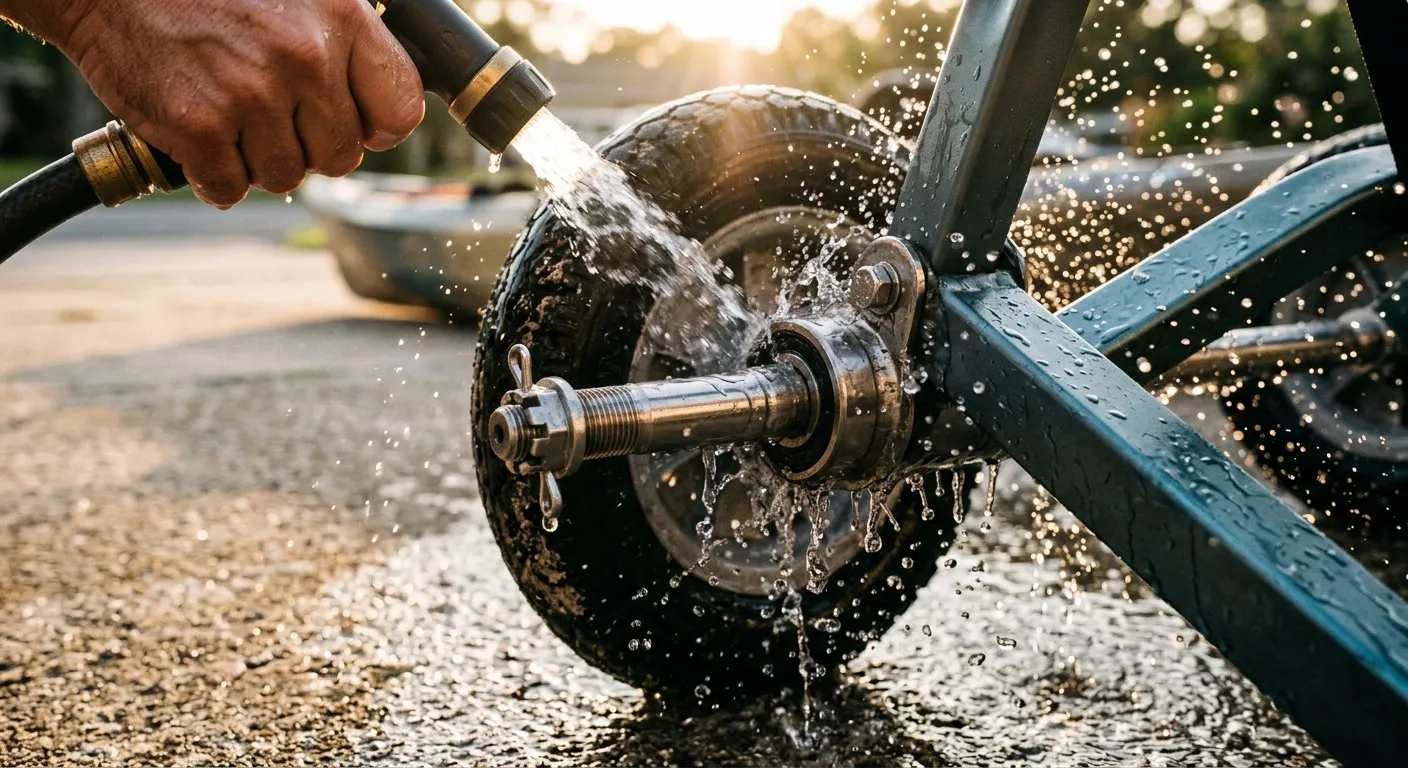
The critical detail: rinse before the salt dries. Salt crystallising in a bearing is what does the damage, and once it has dried in place a quick hose-down does not reach it.
- Rinse the whole cart with fresh water as soon as you get home — sooner if there is a tap at the launch. Low pressure, plenty of volume.
- Concentrate on the wheels and axles. Spin each wheel while rinsing so water gets into the hub. This is where the damage happens.
- Flush inside the frame tubes if the design allows it. Aluminium tube that fills with salt water and does not drain will corrode from the inside.
- Work the moving parts under the water — kickstands, folding joints, adjusters. Grit hides in pivots.
- Dry it properly, ideally in the shade with the wheels off the ground.
Do not use a pressure washer
High pressure drives salt and grit past the bearing seals rather than flushing it out, and it strips protective coatings. A garden hose is the right tool.
Why grease is the wrong answer on a sandy coast
The instinct is to grease everything. On a beach cart, that instinct is wrong for anything exposed.
Grease is sticky, and sticky is exactly what you do not want next to sand. A greased exposed axle collects grit and holds it against the bearing surface, turning the lubricant into a grinding compound. Owners who grease their axles after every beach trip often find the wheels stiffen faster, not slower.
Use a dry PTFE or silicone lubricant on exposed axles and pivots instead. It lubricates without giving sand anything to cling to. Save marine grease for genuinely sealed bearings where the grit cannot reach it in the first place.
Bearings and axles, in more detail
- Pull the wheels off periodically. Most cart wheels are pin- or clip-retained and come off in seconds. Every few trips, take them off and flush the housing out properly.
- Inspect the axle for pitting and scoring. A scored axle chews through bearings and seals.
- Check for play by rocking the wheel on the axle. Developing play means the housing is wearing, and it accelerates.
- Carry spare retaining pins. They are tiny, they are cheap, and losing one on a beach means carrying the boat. See replacement parts.
- Listen. A dry, gritty rumble from a wheel is a bearing telling you it has sand in it.
Storage and UV
- Store indoors or under cover. UV embrittles polyurethane, polypropylene and nylon over years.
- Store it dry and unfolded where you can, so trapped water cannot sit in a joint.
- Deflate balloon wheels slightly for long storage, and keep them out of direct sun — heat plus UV is the worst combination for a polyurethane tyre.
- Do not store the cart with the boat on it. Sustained load flattens foam pads and, on scupper carts, causes hull creep.
- Loosen straps for storage. Webbing under permanent tension takes a set and weakens.
A maintenance schedule you might actually follow
| When | Do this |
|---|---|
| Every salt or sand trip | Fresh water rinse, spin the wheels while rinsing, dry in shade. |
| Before every trip | Check retaining pins and clips, check the kickstand bolt, glance at the strap webbing. |
| Every few trips | Pull the wheels, flush the housings, dry lubricant on axles and pivots. |
| Monthly in season | Check for play in wheels and folding joints. Tighten hardware — nyloc nuts still back off. |
| Annually | Inspect pads for compression and tearing, webbing for abrasion and UV chalking, frame for cracks and corrosion. Replace what is worn before it fails. |
| End of season | Full clean, dry thoroughly, store indoors with straps loosened. |
Repairability is a purchase decision
All of this assumes you can buy the part when something does wear out. Parts availability varies enormously between brands — from lifetime warranties with full parts breakdowns to no spares channel at all. We rate it for every cart we hold in replacement parts and repairability.
Check this against your own boat
General advice only gets you so far. The finder runs your kayak, your loaded weight and your launch terrain against every cart we hold.
Other guides
Start here
How to choose a kayak cart
The full decision process: rigged weight first, then hull shape, then terrain, then storage.
Technique
Strapping a kayak to a cart properly
Strap slip is the second most common cart complaint and it is almost always fixable.
Hull safety
Scupper cart safety
Scupper holes are moulded drains, not designed load points.
Terrain
Moving a kayak across soft sand
The surface that defeats most carts.