YakAttack
TowNStow Bunkster
Made in the USA with a lifetime warranty and a fully documented parts breakdown. Individual bunks, wheels, kickstands and hardware are orderable.
Ownership
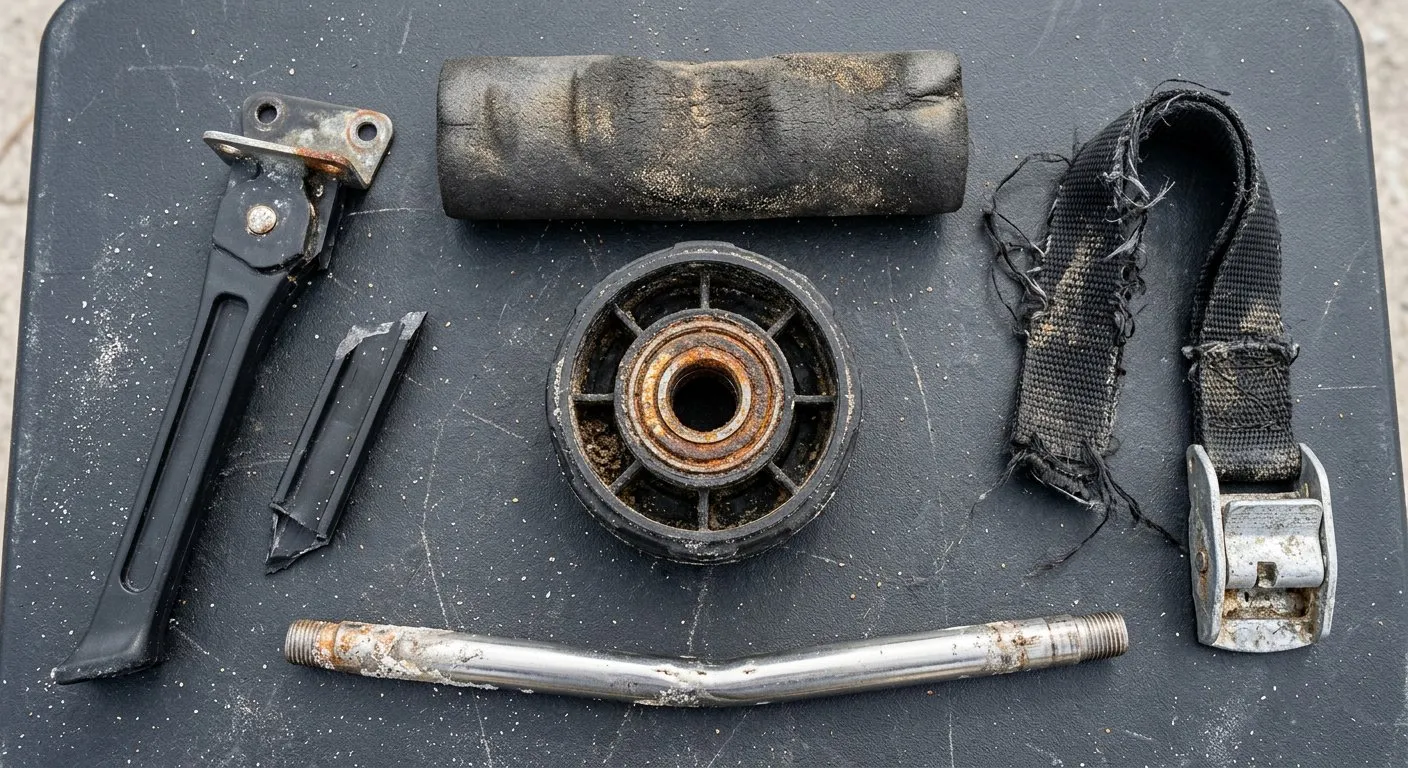
Carts rarely die all at once. A kickstand snaps, a strap lock breaks, a bearing fills with sand. Whether that is a ten-dollar fix or a new cart depends entirely on whether the manufacturer sells the part — and almost no review ever mentions it.
Why this page exists
A cart with excellent parts support at a higher price is often cheaper over five years than a budget cart that becomes landfill when one moulded part fails. We rate parts availability as a first-class attribute, not a footnote.
YakAttack
Made in the USA with a lifetime warranty and a fully documented parts breakdown. Individual bunks, wheels, kickstands and hardware are orderable.
Railblaza
Railblaza sells the cart as separable components and replacement wheels, straps, kickstands and axles are widely stocked. Wheels can be swapped between Kiwi, SandTrakz and pneumatic without replacing the frame.
Wheeleez
Wheeleez sell the balloon wheels separately in 24, 30, 42 and 49 cm sizes, and the wheels are commonly retrofitted onto other carts and DIY frames.
Wheeleez
Wheels and axle parts available from Wheeleez.
Suspenz supply replacement wheels and hardware; availability outside the US is patchier.
Wilderness Systems
Available through Wilderness Systems dealers.
Bonnlo
No published spare-parts channel. Budget carts in this class are usually replaced, not repaired.
Ratings reflect what we could verify about published parts channels, not a guarantee of stock in your country. Availability outside the manufacturer’s home market is frequently worse than these ratings suggest.
Compiled from owner reports across the carts in our database. These are the components that come up again and again, in roughly the order you are likely to meet them.
The single most reported breakage. They take a shock load every time you drop the bow, and they collapse or loosen on uneven ground.
What to do: Worth holding a spare if your cart sells them separately. Check the fixing bolt before every trip — nyloc nuts still back off.
Plastic strap locks snap, and factory buckles without teeth let the strap creep under load. Strap slip then drags the cart out of position.
What to do: Replace with a 25 mm (1 in) cam strap. This is the cheapest meaningful upgrade you can make to almost any cart.
Sand ingress is the killer. Grit works into the bearing, the wheel stiffens, and eventually the axle housing wears oval.
What to do: Rinse after every salt or sand outing. Carry the axle retaining pins — losing one on a beach ends the trip.
Punctures, valve failures and quality-control problems on inflatable wheel options. A flat tyre on soft ground is a total failure.
What to do: Carry a spare tube and a pump, or buy airless wheels and accept the trade-off in cushioning.
They compress, tear and absorb saltwater over time. Worn pads let the hull sit on the frame, which is how carts scratch and dent boats.
What to do: Inspect annually. Closed-cell foam or pool noodle is a common field repair; some brands sell proper replacements.
Every fold point is a wear point. Play develops, then the frame racks under load and tracks crooked.
What to do: Check for play by rocking the assembled cart. Tighten or replace pivot hardware before it elongates the holes.
Small, cheap, and it lives in the car. Every item here addresses a failure that would otherwise mean carrying a loaded boat.
Owner modification is extremely common, and the two we see most often are both responses to real design shortcomings: adding contoured cradles so flat pads stop letting rounded hulls roll, and replacing the factory strap with a proper cam strap.
Where we stop
We will not publish load-bearing DIY plans. We found multiple accounts of home-built PVC carts failing under loaded fishing kayaks, and a frame that collapses mid-carry drops a heavy boat onto whatever is beneath it. Modify pads, straps and wheels freely. Be much more careful with anything that carries the load.
Parts availability sits alongside fit, capacity and terrain in every cart record we hold. Start from your boat and the ground you cross.